
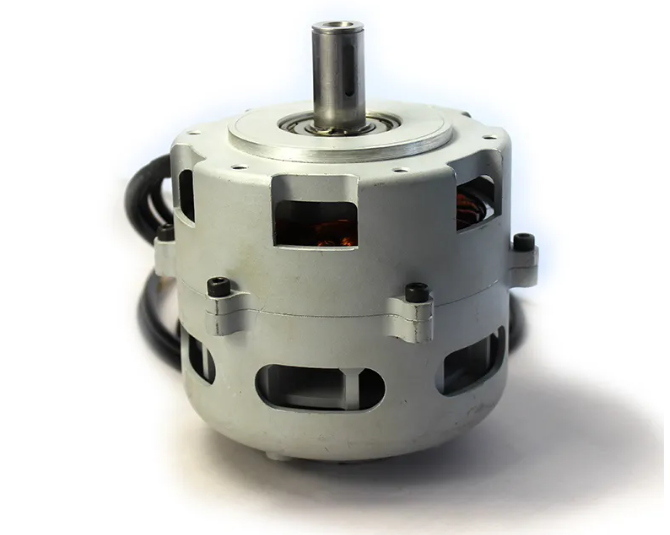
Axial Flux vs Radial Flux Motors: What China’s Breakthrough Means for Drones and UAVs
—
Introduction
On July 29, 2026, CCTV aired a segment from a factory in Jinhua, Zhejiang Province. The headline: China had achieved the world’s first mass production line for axial flux motors — 300,000 units per year, five production lines running at full capacity, orders booked through Q1 2027. Exports to Turkey surged 520%; shipments to Thailand grew 150%. Products now reach over 30 countries.
For the drone and UAV industry, this isn’t just another manufacturing milestone. It’s the moment a 200-year-old motor topology finally became commercially available at scale — and it changes the power density equation for everything from heavy-lift multirotors to eVTOL aircraft.
But what exactly is an axial flux motor? How does it differ from the radial flux BLDC motors that power every FPV quad, RC plane, and industrial drone on the market today? And most importantly — should drone builders care right now, or is this an industrial story that won’t reach the hobby bench for years?
This article breaks down the axial flux vs radial flux comparison from a drone and UAV perspective, with real performance numbers, honest limitations, and a clear-eyed look at what the next five years hold.
—
The 200-Year-Old Technology That Just Went Mainstream
Faraday’s 1821 Disc Motor — The Original Axial Flux Design
Here’s something that surprises most engineers: the axial flux motor is not new technology. In 1821, Michael Faraday built the world’s first electric motor — a copper disc rotating between the poles of a permanent magnet. Magnetic flux passed axially through the disc (parallel to the output shaft), not radially (perpendicular to it).
Faraday invented the axial flux motor before the radial flux motor existed.
So why did radial flux dominate for two centuries? Three reasons:
1. Manufacturing precision. Axial flux motors require extremely tight tolerances between the rotor and stator discs. A 0.1mm air gap variation creates uneven magnetic forces that destroy bearings. Until the last decade, maintaining this precision at production scale was economically impossible.
2. Material science. Axial flux stators are typically made from soft magnetic composite (SMC) rather than laminated steel. SMC materials with the right combination of magnetic permeability, thermal stability, and mechanical strength were only commercialized recently.
3. Production equipment. Winding copper coils onto a flat disc stator requires fundamentally different machinery than winding onto a cylindrical stator. The specialized winding and assembly equipment simply didn’t exist at scale.
In June 2026, Hangzhou Pandoo Power (盘毂动力) cracked all three problems simultaneously, launching the world’s first high-volume axial flux motor line. One month later, demand had already overwhelmed supply.
Why It Matters Now
The timing isn’t coincidental. Three industries are converging on a shared need for maximum power density in minimum volume:
– Electric vehicles need smaller motors to free up space for larger battery packs
– Humanoid robots need high-torque, lightweight joint actuators
– Drones and eVTOL need the best possible thrust-to-weight ratio — every gram saved on the motor goes directly to payload or endurance
Axial flux technology serves all three industries with the same fundamental advantage: it packs more torque into less space and less weight than any radial flux motor of equivalent power.
—
Axial Flux vs Radial Flux — The Key Differences
Geometry: “Disc” vs “Cylinder”
The fundamental difference is in how magnetic flux travels through the motor:
– Radial flux motor (what you know): The stator is a cylindrical ring of copper windings. The rotor (bell, in outrunner designs) wraps around the outside with permanent magnets. Magnetic flux flows radially — perpendicular to the output shaft. This is the architecture of every FPV drone motor, every RC car motor, and the vast majority of industrial BLDC motors.
– Axial flux motor: The stator is a flat disc with copper windings arranged in a circular pattern. The rotor is a parallel disc with permanent magnets facing the stator. Magnetic flux flows axially — parallel to the output shaft. The motor looks like a thick pancake rather than a cylinder.
This geometric difference produces three cascading advantages:
The Three “50%” Advantages
According to data from Pandoo Power’s production line and confirmed by industry analysts:
|——–|———————-|———————|————-|
| Metric | Radial Flux (typical) | Axial Flux (Pandoo) | Improvement |
| Weight | 100% baseline | 50% of baseline | **50% lighter** |
| Volume | 100% baseline | 50% of baseline | **50% smaller** |
| Material usage | 100% baseline | 50% of baseline | **50% less copper/steel** |
| Power density | 5-8 kW/kg (premium BLDC) | 25.73 kW/kg | **3-5x higher** |
| Torque density | ~100 N·m/kg | 293 N·m/kg | **~3x higher** |
| Max RPM | 30,000-60,000 (FPV) | 18,000 | Lower (design-dependent) |
The power density number deserves emphasis: 25.73 kW/kg exceeds China’s 2040 EV technology roadmap target by 42.94% — and it’s shipping in 2026.
Where the Advantage Comes From
In a radial flux motor, only the outer surface of the cylindrical stator interacts with the rotor magnets. The inner volume of the stator contributes to structural integrity but not to torque production.
In an axial flux motor, the entire face of the disc stator interacts with the rotor magnets. The active magnetic surface area for a given motor volume is dramatically larger. More active area = more torque = higher power density.
Think of it this way: a radial flux motor is like a can of soup — the label (outer surface) is the active area. An axial flux motor is like a pancake — the entire top and bottom surfaces are active. For the same “food volume,” the pancake has far more surface area.
—
What This Means for Drone and UAV Applications
Thrust-to-Weight Ratio Improvements for Multirotors
For multirotor UAVs, motor weight is a direct tax on payload and endurance. Every gram saved on the power system can be reallocated to:
– Larger battery → longer flight time
– Heavier payload (camera, LiDAR, delivery package)
– Stronger airframe → better wind resistance and durability
A typical 7-inch long-range FPV build uses four 2807 motors weighing approximately 55g each — 220g total for the motor set. Replace those with axial flux motors producing equivalent thrust at 50% weight (110g total), and you’ve freed up 110g.
On a 1,500g all-up-weight quad, 110g is a 7.3% weight reduction — which translates directly to 5-8% longer flight time or equivalent additional payload capacity.
For industrial UAVs, the numbers scale dramatically. A heavy-lift hexacopter with six 1,500g motors saves 4.5 kg on the power system alone. That’s an extra high-resolution camera, an additional 15 minutes of hover time, or a larger delivery payload.
VTOL and eVTOL — The Ideal Use Case
Vertical takeoff and landing aircraft face the most demanding power system requirements of any aerial vehicle:
– Hover requires maximum continuous power — unlike fixed-wing cruise where power drops to 30-50% of max
– Weight directly impacts hover efficiency — every gram of motor weight costs watts in hover
– Volume constraints are tight — tilt-rotor and distributed propulsion designs have limited nacelle space
Axial flux motors solve all three problems simultaneously. A 50 kW axial flux motor weighs what a 16 kW radial flux motor weighs. For an eVTOL with eight lift motors, the weight savings on the propulsion system alone can exceed 100 kg — enough to add two additional passengers or dramatically extend range.
This is why every serious eVTOL developer is either evaluating or actively testing axial flux motors. The math is simply too compelling to ignore.
Fixed-Wing UAV Endurance Gains
For fixed-wing mapping and surveillance UAVs, motor efficiency at cruise power (typically 30-50% of max) matters most. While axial flux motors show efficiency gains across the power curve, the weight reduction delivers the primary endurance benefit on fixed-wing platforms — less weight means lower wing loading, which means lower cruise power, which compounds into significantly longer flight times.
—
Will Axial Flux Replace Radial Flux in FPV and RC?
This is the question that matters most to the hobby and prosumer community. The honest answer: not anytime soon, and possibly never for certain applications.
Current Limitations
1. Cost
Pandoo Power’s axial flux motors are priced for automotive and industrial customers. A single motor costs thousands of dollars — not the $25-35 of a premium FPV motor. Economies of scale will reduce costs over time, but the precision manufacturing requirements mean axial flux motors will always carry a premium over radial flux at equivalent power levels.
2. Availability and Sizing
The current production focuses on 20-150 kW motors for automotive, robotics, and industrial UAV applications. Nobody is manufacturing a 30g axial flux motor for 3-inch cinewhoops or a 55g motor for 5-inch freestyle. The minimum viable size for axial flux (given current manufacturing techniques) is significantly larger than what the FPV hobby needs.
3. RPM Limitations
FPV motors regularly spin at 30,000-60,000 RPM. Pandoo’s axial flux motors max out at 18,000 RPM. The flat disc geometry creates different mechanical stress patterns at high RPM — the centrifugal forces that a cylindrical bell handles gracefully become problematic for a thin disc rotor. Higher RPM axial flux designs exist in laboratories, but they’re not on the production roadmap.
4. Ecosystem Maturity
Every FPV flight controller, ESC, and frame is designed around radial flux outrunner motors. ESC timing algorithms (especially FOC) are tuned for radial flux magnetic characteristics. Frame mounting patterns, prop adapter standards, and cooling airflow expectations are all radial-flux-native. Switching to axial flux means rebuilding the entire ecosystem.
Where Radial Flux Still Wins
|————-|———————|
| Application | Why Radial Flux Wins |
| FPV freestyle/racing | Needs $25 motors, 40K+ RPM, crash resilience, ecosystem compatibility |
| Tiny whoops / micro quads | Axial flux minimum size is too large |
| RC cars / boats | Cost sensitivity, existing ecosystem, high RPM requirements |
| Budget builds | Radial flux manufacturing is mature, commoditized, and cheap |
| Applications requiring repairability | Radial flux motors are simple to disassemble, re-bearing, and re-wind |
A Hybrid Future
The most likely outcome is not axial flux replacing radial flux, but axial flux taking over the high-power, weight-sensitive end of the market while radial flux continues to dominate the cost-sensitive, high-RPM, and hobby segments.
The dividing line will likely be around 2-5 kW of continuous power. Below that, the radial flux cost and ecosystem advantages outweigh axial flux benefits. Above that, axial flux becomes the obvious choice — particularly for any application where weight matters and budget allows.
—
X-TEAM’s Position — Radial Flux Excellence While Watching the Horizon
At X-TEAM, we’ve spent over 15 years optimizing radial flux brushless DC motors for RC hobby, FPV drone, UAV, and industrial applications. We’re not threatened by axial flux technology — we’re watching it closely, understanding where it fits, and continuing to push radial flux performance forward.
The radial flux ceiling is still rising:
– N52SH magnets (rated to 150°C) maintain full magnetic flux at temperatures that would partially demagnetize standard N52 magnets — enabling sustained high-power operation without performance fade
– 0.15mm Kawasaki steel laminations reduce eddy current losses at high RPM, improving efficiency by 3-5% over standard 0.20mm laminations
– Single-strand winding with optimized fill factor reduces internal resistance and heat generation compared to multi-strand alternatives
– Unibell construction (machined from a single aluminum block) provides superior crash resistance and precise balance compared to two-piece pressed bells
For the vast majority of drone builders, FPV pilots, and RC enthusiasts reading this, a well-engineered radial flux motor with premium magnets and thin laminations remains the best choice — and will continue to be for years.
When axial flux technology matures to the point where it makes sense for sub-5 kW drone applications, we’ll be ready. But we won’t rush a product to market just to have “axial flux” on the spec sheet. Performance and reliability come first.
—
FAQ
When will axial flux motors be available for FPV drones?
Realistically, not within the next 3-5 years. The minimum viable size for axial flux (with current manufacturing techniques) is significantly larger than FPV motor sizes, and the cost structure is orders of magnitude higher. Industrial and heavy-lift UAV applications (5 kW+) will see axial flux adoption first.
Should I wait for axial flux before building my next quad?
Absolutely not. A premium radial flux motor with N52SH magnets and thin laminations delivers exceptional performance today at a fraction of what axial flux would cost even if it were available in FPV sizes. Build with what exists, fly, and enjoy — axial flux will come to the hobby when it’s ready, not before.
Are axial flux motors more efficient at low RPM?
Axial flux motors generally show flatter efficiency curves than radial flux across the RPM range, but the advantage is most pronounced at medium-to-high load. At very low RPM (cruise power for endurance UAVs), the efficiency difference narrows. The primary advantage for UAV applications is weight reduction, not dramatically higher cruise efficiency.
Do axial flux motors run cooler?
The pancake geometry provides more surface area for passive cooling relative to motor volume, which helps. However, the higher power density means more total heat is generated per unit volume, so thermal management is a design consideration. In practice, adequate cooling can be achieved with proper airflow, but a 25 kW axial flux motor running at full power will absolutely need active cooling — just like any 25 kW motor would.
Can I use my existing ESC with an axial flux motor?
Probably not well. Axial flux motors have different inductance, back-EMF, and magnetic saturation characteristics than radial flux motors. ESC timing algorithms — especially sensorless FOC — are tuned for radial flux motor parameters. Using a radial-flux-tuned ESC on an axial flux motor would likely result in poor efficiency, rough startup, or even desync at high load. Dedicated axial flux ESCs are being developed in parallel with the motors.
What’s the biggest misconception about axial flux motors?
The biggest misconception is that axial flux is “new” technology. It predates radial flux by decades — Faraday’s 1821 motor was axial flux. The breakthrough in 2026 isn’t the invention of axial flux; it’s the manufacturing precision and materials science that finally made mass production economically viable after 200 years.
—
Conclusion
The axial flux motor breakthrough is a genuine milestone in electric propulsion — not hype, not vaporware, not a laboratory curiosity. Mass production at 300,000 units per year with global demand outpacing supply proves that axial flux has crossed the chasm from research project to commercial product.
For the drone and UAV industry, the immediate impact will be felt in heavy-lift multirotors, VTOL aircraft, and eVTOL development — applications where every gram of motor weight directly constrains payload and endurance. The 50% weight reduction that axial flux delivers is simply too large to ignore in these segments.
For FPV pilots, RC hobbyists, and prosumer drone builders, the radial flux motor you’re flying today is not obsolete. It’s the product of 15+ years of continuous refinement, and it’s still getting better. Axial flux will come to smaller platforms when the technology matures and costs come down — but that’s a 5-10 year horizon, not a next-season shopping decision.
The takeaway: understand axial flux, appreciate the breakthrough, and keep flying what works. The future is coming — but today’s radial flux motors are already extraordinarily capable.
—
Published by X-TEAM — Brushless DC Motor Manufacturer since 2007. Follow our blog for more deep dives into motor technology, maintenance guides, and industry analysis.