
In the development of modern underwater equipment, which is increasingly intelligent and high-performance, the choice of power systems has become particularly important. Whether it is underwater robots, autonomous submersibles, or inspection and operational devices, all must operate reliably in high-humidity, high-pressure, or fully submerged environments. BLDC motors are increasingly used in underwater applications due to their high efficiency, compact structure, and excellent controllability. However, underwater conditions place strict requirements on sealing, corrosion resistance, and thermal management, making their application more complex. To fully utilize their advantages, both structural design and application scenarios must be carefully considered.
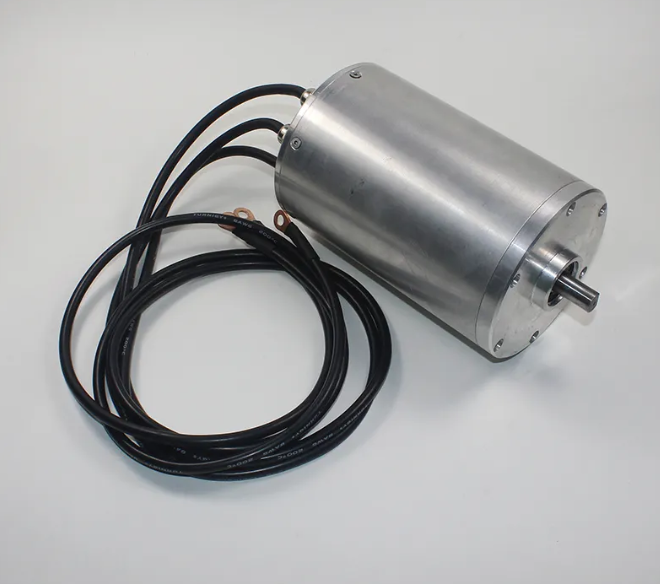
Basic Requirements of Underwater Environments for Motors
In underwater applications, motors must simultaneously meet waterproofing, corrosion resistance, and stable operation requirements.
- High waterproof rating: IP68 or higher protection is required to prevent water ingress into internal components.
- Strong corrosion resistance: Materials must withstand long-term exposure to seawater or chemical environments.
- Stable output capability: The motor must maintain consistent performance under varying water pressure conditions.
- Reliable sealing structure: Bearings, housings, and wiring sections require comprehensive sealing design.
Advantages of BLDC Motors in Underwater Applications
BLDC motors have inherent advantages that make them suitable for underwater environments.
- Brushless structure: Reduces mechanical wear and improves long-term reliability in sealed environments.
- High efficiency: Minimizes energy loss and helps extend the operating time of underwater devices.
- Compact size: Easy to integrate into space-limited underwater robots or systems.
- High control precision: Suitable for underwater positioning and fine motion control.
- Lower heat generation: Helps reduce heat accumulation in sealed environments.
Key Technical Treatments for Underwater Applications
Although BLDC motors have a strong foundation for use, specialized engineering is required to adapt them to underwater environments.
- Full sealing design: Completely enclosed structure prevents water from entering the motor.
- Potting process: Epoxy resin or similar materials are used to encapsulate internal components.
- Specialized bearing treatment: Waterproof lubrication and corrosion-resistant bearing designs are applied.
- Anti-corrosion coatings: Metal components are surface-treated to extend service life.
- Pressure-adaptive design: Structural reinforcement ensures stable operation at different water depths.
Typical Applications in Underwater Equipment
BLDC motors are already widely used in various underwater systems and play an important role.
- Underwater robots: Used for inspection, sampling, and maintenance tasks.
- Remotely operated vehicles (ROVs): Provide stable propulsion for deep-sea exploration.
- Underwater propulsion systems: Used in small submersibles and mobile underwater platforms.
- Environmental monitoring devices: Support long-term underwater data collection operations.
The use of BLDC motors in underwater equipment is entirely feasible, provided that appropriate structural design and protective treatments are implemented. By strengthening sealing, corrosion resistance, and thermal management, their stability and service life in complex underwater environments can be significantly improved. As underwater robotics and intelligent marine systems continue to evolve, BLDC motors are becoming an increasingly important power solution, providing reliable support for deep-sea exploration and underwater operations.