
With the continuous expansion of brushless DC motor (BLDC) applications, the difference between inner rotor and outer rotor structures has become one of the most fundamental yet often overlooked factors in motor selection. Many users tend to focus only on power or speed, while ignoring how motor structure deeply affects torque output, response speed, and heat dissipation. In reality, neither structure is absolutely better—the “right choice” depends entirely on the application requirements such as speed, force, and stability.
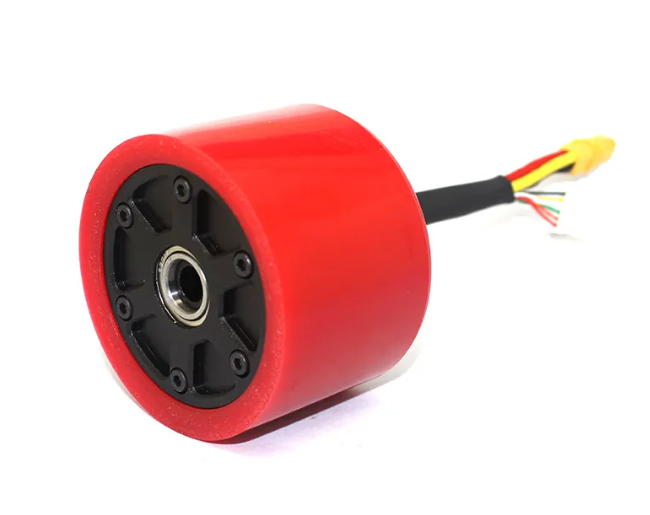
Basic Structural Differences Between Inner and Outer Rotor Motors
To determine which one is suitable, it is essential to first understand their mechanical structure differences.
- Inner rotor motor: the rotor is located inside and rotates at high speed, while the stator remains fixed outside
- Outer rotor motor: the rotor surrounds the outside and rotates, with the stator fixed inside
Characteristics and Advantages of Inner Rotor Motors
From the perspective of high-speed performance and dynamic response, inner rotor motors excel in lightweight and high-RPM applications.
- Higher rotational speed, suitable for systems requiring speed and responsiveness
- Lower rotational inertia, allowing faster acceleration and deceleration
- Compact structure, easier to achieve lightweight design
- Commonly used in drones and high-speed RC racing cars
- Suitable for high-frequency speed control and precision applications
Characteristics and Advantages of Outer Rotor Motors
From the perspective of torque output and stable operation, outer rotor motors are more “power-oriented.”
- Higher torque output, stronger low-speed load capacity
- Smoother operation, suitable for continuous load conditions
- Larger heat dissipation area, ideal for long-duration operation
- Commonly used in fans, off-road RC vehicles, and climbing applications
- More efficient in low-speed, high-load scenarios
Application Differences Between Inner and Outer Rotor Motors
Different structures define a clear division of roles in industrial and hobby applications, so selection must be based on real operating conditions.
- Inner rotor: suitable for racing drones, RC cars, and high-speed precision equipment
- Outer rotor: suitable for fan systems, crawler RC vehicles, and high-torque devices
- Inner rotor emphasizes speed and responsiveness
- Outer rotor emphasizes stable output and load capacity
Which One Is Better: Inner Rotor or Outer Rotor?
Many users ask which one is “stronger,” but motor selection is fundamentally about application matching rather than performance ranking.
- Inner rotor is better for high-speed and responsive control applications
- Outer rotor is better for torque-heavy and stable operation scenarios
- Both can be optimal depending on the working conditions
- There is no absolute winner—only the right match for the system
Inner rotor and outer rotor motors differ mainly in how they deliver power: one focuses on speed and responsiveness, while the other emphasizes torque and stability. The key is not to compare which is better, but to choose based on real application needs. For engineers and businesses, selecting a reliable motor supplier is also critical. As a professional brushless motor manufacturer, X-TEAM provides a wide range of inner and outer rotor BLDC motor solutions for RC, industrial, and smart device applications, helping customers achieve more precise power matching and improved system performance.