
Brushless motors are widely used in drones, robots, power tools, and industrial equipment. However, in practice, even if the motor is correctly selected, improper tuning can still cause issues such as startup jitter, unstable speed, or excessive heat. Since these motors rely on electronic speed controllers (ESCs) and electronic commutation, their performance depends not only on the motor itself but also on parameter settings and system matching. Therefore, tuning must be performed step by step.
Basic Checks Before Tuning
Before making any adjustments, it is essential to ensure that the basic connections and power supply are correct, otherwise subsequent tuning will be unstable.
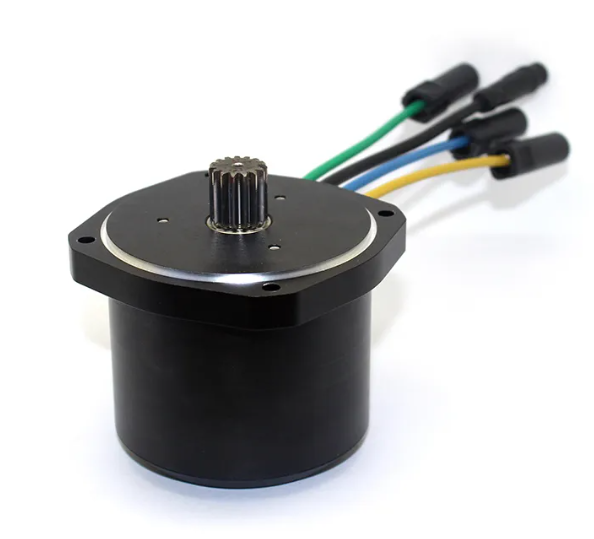
- Check that the three-phase wires are correctly connected and secure to avoid poor contact or phase sequence errors that can cause reverse rotation or jitter.
- Verify that the ESC matches the motor’s voltage and current specifications to prevent overload or protection trips.
- Use a stable power supply for testing to prevent voltage fluctuations from affecting startup and speed control.
Basic ESC Parameter Settings
The ESC is the control core, and proper parameter settings directly affect the motor’s overall performance.
- Calibrate the throttle range so that the input signal matches the ESC output.
- Choose the startup mode based on the load: fast start for light load, soft start for heavy load.
- Set the timing angle to match the motor type to avoid efficiency loss or excessive heating.
- Enable voltage protection to prevent battery over-discharge or system damage.
No-Load and Light-Load Testing
Before running under full load, no-load and light-load tests are needed to verify basic stability.
- Observe low-speed startup for smooth operation and check for jitter or stalling.
- Confirm that the motor rotates in the correct direction; adjust wiring or settings if necessary.
- Gradually increase speed and monitor for unstable fluctuations.
- Conduct light-load operation to ensure the motor enters a normal working state.
Loaded Operation and Optimization
Once no-load operation is stable, real-world load testing is required to further optimize performance.
- Gradually increase the load to avoid sudden full-load shocks.
- Monitor temperature rise to ensure the cooling system supports long-term operation.
- Adjust control parameters to improve speed stability and response.
- Track current changes to avoid long-term overcurrent that could reduce lifespan.
Common Issues and Optimization
Typical issues during tuning often follow predictable patterns and can be addressed systematically.
- Startup jitter is usually caused by mismatched commutation or parameters.
- Excessive heat is often due to high load or inefficient operating range.
- Unstable speed is often related to power quality or signal interference.
- Reverse rotation is usually due to incorrect wiring or parameter settings.
The key to brushless motor tuning is not just making the motor spin, but ensuring stable, efficient operation under target conditions. This requires step-by-step work from basic checks, ESC setup, no-load testing, to load optimization. For users needing high-reliability power systems, X-TEAM offers brushless motor and drive solutions, specializing in high-performance BLDC systems. It cover drones, electric boats, and industrial equipment, and support customization and OEM services, helping users achieve efficient system matching and optimized stable operation.