
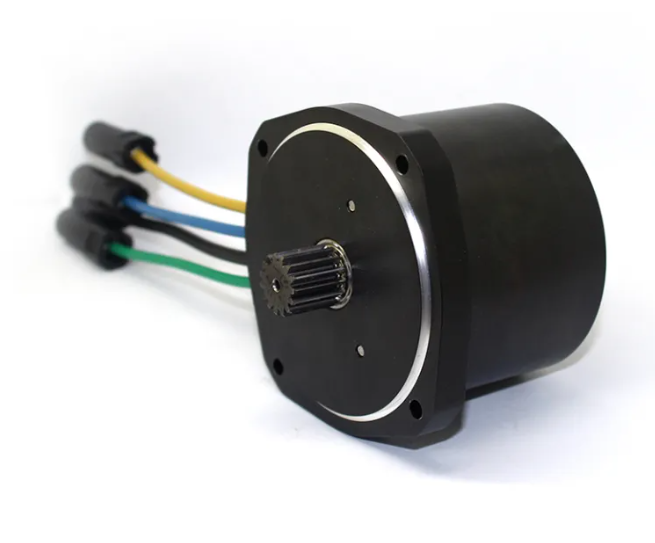
Brushless motors are widely used in drones, robots, power tools, electric boats, and industrial automation due to their high efficiency, long lifespan, and low noise. Choosing the right motor involves more than looking at power alone—speed, torque, voltage, and operating conditions all play a crucial role. A well-matched motor can improve performance, reduce energy consumption, and extend service life, ensuring the equipment works reliably under various conditions.
Select the Motor According to the Application
Different applications place different demands on brushless motors, so understanding the working environment is essential before choosing a model.
- Drones need lightweight, fast-response motors to maintain flight stability and control.
- Robots require higher torque and precise control for accurate movements.
- Electric boats and marine equipment require motors that balance power output with environmental protection.
- Industrial automation focuses on continuous operation and long-term reliability.
Match Voltage and Power
Voltage and power are fundamental specifications that directly affect motor performance and efficiency.
- Motor voltage must match the battery and controller to avoid underperformance or damage.
- Insufficient power can lead to weak output and overheating under load.
- Excessive power may increase energy consumption and cost.
- Providing a performance margin ensures stability under demanding conditions.
Balance Speed and Torque
Speed and torque are interrelated performance indicators, and different applications prioritize them differently.
- High-speed motors suit lightweight applications like drones and fans.
- High-torque motors are ideal for heavy-load applications such as robotic joints and mechanical transmissions.
- Choosing a balance between speed and torque ensures optimal operation rather than focusing on one aspect.
Consider KV Rating and Efficiency
KV rating indicates the RPM per volt and is an important reference, but it must be considered alongside efficiency.
- High-KV motors have higher speed but lower torque.
- Low-KV motors provide greater torque, suitable for heavy-load or stable-output scenarios.
- Different KV ratings fit different applications and load requirements.
- Operating in the motor’s high-efficiency range reduces heat and extends lifespan.
- Consistent operation within the optimal efficiency range ensures stable performance.
Consider Structure and Environmental Compatibility
Installation conditions and environment impact real-world motor performance, so structural design matters.
- Outdoor equipment requires dustproof, waterproof, and corrosion-resistant designs.
- Continuous-operation devices benefit from motors with efficient heat dissipation.
- Motor dimensions must fit the available installation space.
- Noise and vibration control is crucial for precision or consumer applications.
Selecting a brushless motor requires considering voltage, power, speed, torque, and operating environment together. X-TEAM offers high-performance BLDC motors and power systems for drones, electric boats, robots, and industrial equipment, providing reliable, efficient, and customizable solutions to meet various application needs.