
In today’s rapidly advancing motor technology landscape, sensorless BLDC motors are widely used in drones, power tools, and industrial equipment due to their simplified structure and cost advantages. Unlike traditional sensored control systems, they do not rely on Hall sensors or encoders to detect rotor position. Instead, they estimate operating conditions through electrical signals themselves. This approach reduces hardware complexity and improves system reliability. However, achieving stable operation requires advanced control algorithms and careful system design. Understanding how sensorless BLDC motors work helps in better selection and application design.
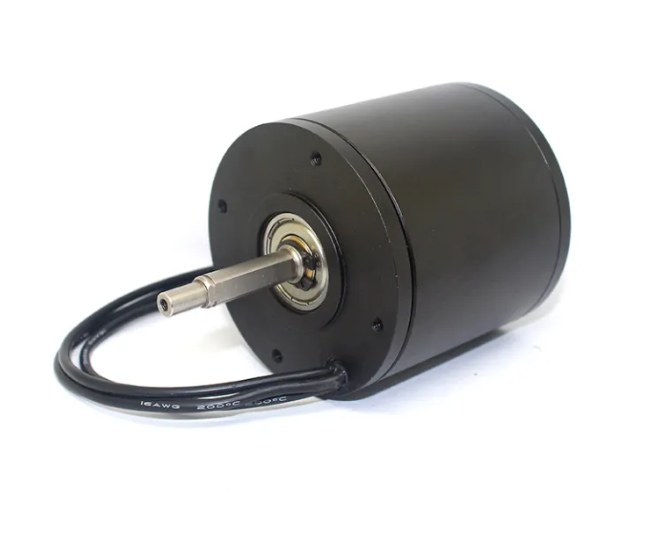
Basic Working Principle of Sensorless BLDC Motors
The core of sensorless BLDC operation lies in estimating rotor position through electrical signals to achieve electronic commutation.
- Back EMF signal dependence: Rotor position is determined by detecting changes in back electromotive force in the windings.
- No position sensors required: Eliminates Hall sensors or encoders, simplifying motor structure.
- Electronic commutation drive: The controller switches three-phase currents based on estimated position to maintain rotation.
- Open-loop to closed-loop transition: Start-up typically uses open-loop control before switching to closed-loop operation once stable speed is reached.
Back EMF Detection Mechanism
Back electromotive force is the key signal source in sensorless control, directly reflecting rotor movement.
- Generated by windings: Voltage is induced when rotor magnets cut through stator windings.
- Zero-crossing detection: The controller estimates commutation timing by detecting zero-cross points of back EMF.
- Three-phase monitoring: The controller continuously observes the unpowered phase voltage.
- High signal processing requirement: Filtering and algorithm optimization are needed to reduce noise interference.
Start-up and Low-Speed Control Methods
Since back EMF cannot be reliably detected at low speed or standstill, special strategies are required.
- Rotor alignment: A short energizing step is used to determine initial rotor position.
- Open-loop acceleration: The motor is gradually accelerated using fixed-frequency control.
- Transition to closed-loop: Once a certain speed threshold is reached, back EMF-based control takes over.
- Anti-stall design: Algorithms prevent misalignment or stalling during start-up.
Control Algorithms and System Implementation
The stability of sensorless control largely depends on algorithm design and system optimization.
- Digital signal processing: Microcontrollers or DSPs analyze voltage and current signals in real time.
- PWM control: Pulse-width modulation precisely regulates output power.
- Speed estimation: Back EMF is used to calculate real-time motor speed.
- Anti-interference optimization: Filtering and compensation improve signal stability.
- Dynamic load adaptation: Control parameters adjust automatically under changing load conditions.
Sensorless BLDC motors achieve efficient operation without physical sensors by relying on back EMF detection and advanced control algorithms. Although they require more sophisticated control strategies during low-speed operation, their advantages in simplified structure, lower cost, and higher reliability make them widely used across multiple industries. With continuous improvements in control algorithms and processing power, sensorless BLDC motors are moving toward higher precision and broader application scenarios, offering more flexible solutions for modern electric drive systems.