
In real-world operation, heating is a normal phenomenon for brushless DC motors (BLDC). However, when the temperature rises too quickly, stays consistently high, or even causes casing overheating and performance degradation, it indicates that the system is operating under an abnormal condition. In most cases, this is not a quality issue of the motor itself, but rather the combined result of load mismatch, power supply limitations, ESC settings, and insufficient cooling. Simply replacing the motor without identifying the root cause often leads to the same problem recurring. A system-level analysis is required to effectively control temperature rise and improve overall stability.
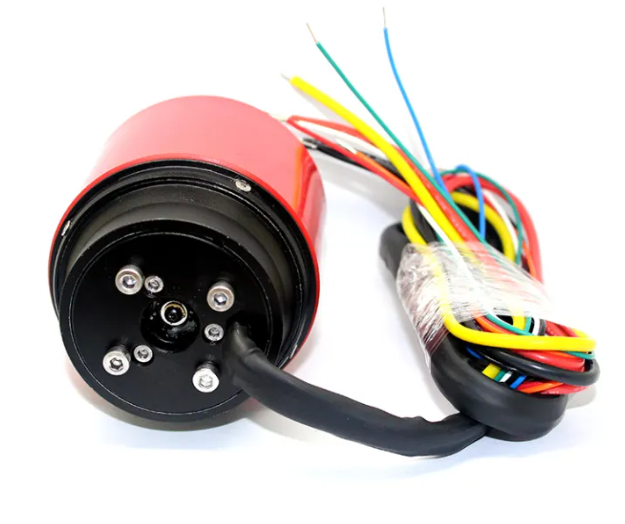
Why Brushless Motors Overheat Severely?
Brushless motors naturally generate heat during operation, but abnormal temperature rise usually indicates issues in current, load, or efficiency. A system-level understanding of power loss paths is necessary to identify the root cause.
- Excessive current increases copper losses in the windings, causing continuous heat accumulation during high-load operation
- Load exceeding the design range forces the motor to draw higher current to maintain speed and torque output
- Improper KV-to-voltage matching causes the motor to operate in a low-efficiency region where more energy becomes heat rather than output power
- Unstable ESC commutation or control strategy increases switching losses and additional heat generation
Heat Issues Caused by Load and Improper Selection
Many overheating problems originate from improper selection rather than usage conditions. When the motor operates outside its optimal efficiency range for long periods, temperature will continuously increase.
- Incorrect KV selection leads to poor matching between speed and torque, reducing efficiency
- Insufficient torque reserve forces the motor to draw more current to compensate for load demand
- Continuous operation near rated load leads to persistent temperature buildup in windings and magnets
- Excessive mechanical resistance, such as poor bearings or tight transmission systems, increases additional load
Impact of Power Supply and Control System on Temperature Rise
The operation of a brushless motor heavily depends on the power supply and control system. Any instability in these systems can directly result in abnormal current and overheating issues.
- Insufficient supply voltage forces the system to increase current to maintain output power
- Improper ESC parameter settings reduce efficiency and push the motor into suboptimal operating conditions
- PWM frequency or control strategy mismatch introduces additional switching losses
- Voltage fluctuations or weak power supply stability increase energy loss and heat generation
Temperature Accumulation Due to Poor Cooling Conditions
Even when the motor operates normally, insufficient cooling can still lead to continuous temperature rise because heat cannot be dissipated effectively.
- Enclosed installation space limits airflow and prevents efficient heat dissipation
- Lack of cooling design such as airflow or heat sinks reduces thermal performance
- Long continuous operation without cooling intervals leads to heat accumulation
- High ambient temperature reduces overall cooling efficiency
How to Effectively Reduce Brushless Motor Heating?
Solving overheating issues requires system-level optimization rather than single-point adjustments. Only a holistic approach can ensure long-term stable operation and controlled temperature levels.
- Re-match KV and torque specifications based on actual load requirements to improve efficiency
- Optimize power supply stability to prevent excessive current draw
- Adjust ESC parameters to reduce unnecessary switching losses
- Improve cooling design, such as adding airflow or ventilation paths
- Control continuous runtime to avoid prolonged full-load operation
Overheating in brushless motors is fundamentally the result of system matching and operating conditions rather than a single component issue. Replacing the motor alone rarely solves the problem. Only by optimizing selection, load, power supply, control, and cooling together can temperature be effectively controlled while improving system stability and lifespan. For high-load or long-duration applications, system design is far more critical than individual parameter adjustments. As a professional brushless power system manufacturer, X-TEAM provides a wide range of high-performance BLDC motor solutions widely used in industrial equipment, RC models, drones, and automation systems, helping customers achieve more stable and efficient power output.