
DC motors are one of the most common driving devices in modern machinery and electronic equipment. Depending on their structure and working principle, they can be classified into brushed DC motors (BDC) and brushless DC motors (BLDC). Although both types convert electrical energy into mechanical energy, they differ significantly in working principle, structural characteristics, performance, and applications. Understanding these differences helps engineers choose the most suitable drive solution for industrial, automotive, robotic, and household applications.
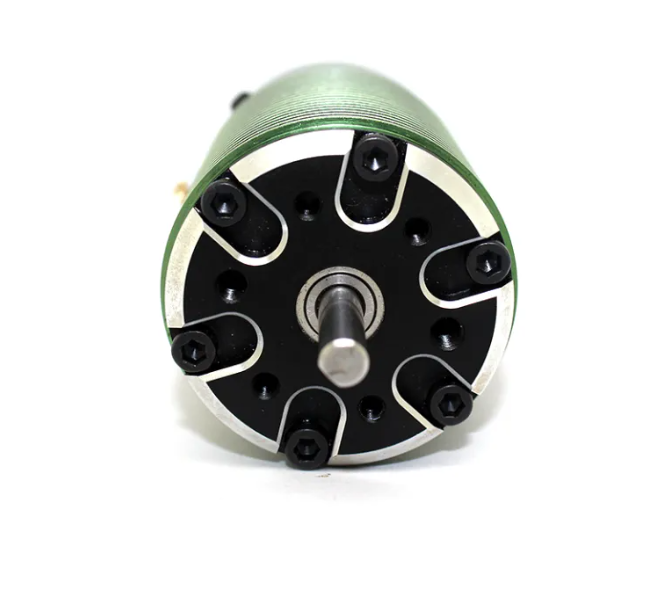
The main feature of brushed DC motors is current commutation through brushes and a commutator. Its basic structure includes a stator, rotor (armature), commutator, and brushes. When powered, the armature windings generate a magnetic field that interacts with the stator’s permanent magnets or field coils, producing torque to rotate the rotor. The brushes and commutator periodically reverse the current to maintain continuous rotation. This simple design is cost-effective, easy to control, and performs well at low speeds with high torque, making it widely used in small household appliances, fans, toys, and some low-cost industrial equipment.
In contrast, brushless DC motors eliminate brushes and mechanical commutators, using an electronic controller for commutation. In a BLDC motor, the rotor typically consists of permanent magnets, and the stator contains winding coils. The controller energizes the stator coils in sequence according to rotor position (detected via Hall sensors or sensorless algorithms), creating a rotating magnetic field that drives the rotor. Without brush friction, BLDC motors operate more smoothly, have longer lifespans, and require less maintenance.
Performance-wise, brushless DC motors offer high efficiency, high speed, low noise, low vibration, and long service life. Without brush friction losses, BLDC motors generate less heat during continuous operation and can reach efficiencies of 85%-90%, significantly higher than brushed motors’ 70%-75%. Moreover, electronic commutation enables precise speed and torque control, making BLDC motors ideal for precision devices, robotics, drones, air conditioning fans, and electric vehicles.
Brushed DC motors, although simple, have notable drawbacks. Brush and commutator friction causes wear, requiring regular maintenance; they generate sparks and noise, affecting reliability; and they have lower efficiency and higher heat generation at high speeds. BLDC motors avoid these issues, often lasting 3-5 times longer, and perform better in automated, high-precision systems.
In terms of control, brushed motors typically adjust speed via voltage variation or simple PWM (pulse-width modulation), while brushless motors rely on electronic drivers and control algorithms, enabling closed-loop control of speed, position, and torque. This makes BLDC motors more compatible with sensors, microcontrollers, and industrial automation systems, meeting modern demands for precision control.
In summary, the fundamental difference between brushed and brushless DC motors lies in current commutation: brushed motors rely on mechanical brushes and a commutator, whereas brushless motors use electronic control. Each has advantages and disadvantages: brushed motors are simple and low-cost but have shorter lifespans, higher noise, and lower efficiency; brushless motors are efficient, durable, low-maintenance, and highly controllable but cost more. With the growth of industrial automation, smart home devices, and electric vehicles, BLDC motors have a broader future application, while brushed motors remain suitable for low-cost, low-demand applications.
Understanding the working principles and performance differences of these motors helps engineers design motor drive systems that balance performance, cost, and reliability.