
In real-world motor applications, temperature control is one of the key factors determining performance stability and service life. Although BLDC motors are more efficient and generate less loss compared to traditional motors, they still produce heat under high load or long-duration operation. If cooling design is not properly implemented, it may lead to performance degradation, efficiency loss, or even damage. Therefore, effective thermal management is essential. Through structural optimization and system-level coordination, the stability of motors under complex working conditions can be significantly improved.
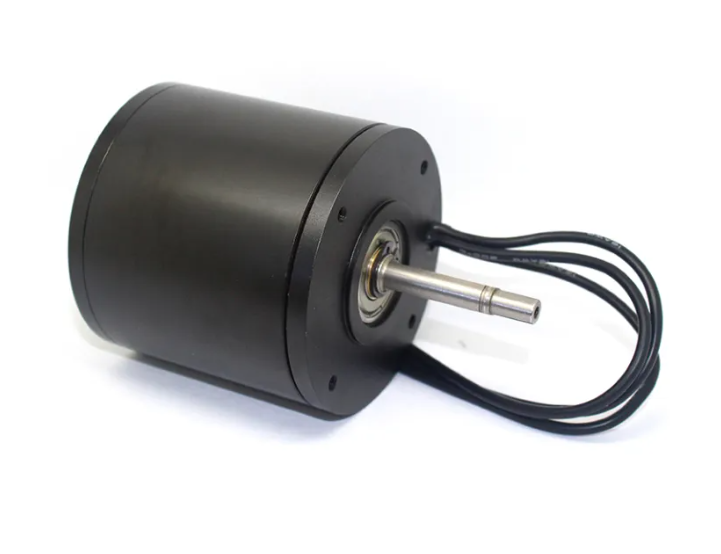
Natural Cooling and Structural Optimization
Natural cooling is the most basic and commonly used method, relying on structural design to improve heat dissipation efficiency.
- Increased heat dissipation surface: Optimized housing design or added cooling fins increase air contact area.
- High thermal conductivity materials: Materials such as aluminum alloys improve heat transfer efficiency.
- Optimized housing structure: Reduces heat accumulation zones and distributes heat more evenly.
- Improved airflow: Structural design enhances natural convection cooling performance.
Air Cooling Methods
Air cooling is the most widely used active cooling method, relying on airflow to remove heat.
- Built-in fan design: Fans inside the motor or drive system improve air circulation.
- External forced air cooling: External fans or duct systems enhance heat dissipation.
- Directional airflow optimization: Air channels are designed to focus airflow on heat-generating areas.
- Suitable for medium to high load: Commonly used in continuously operating or medium-power applications.
Liquid Cooling and High-Efficiency Thermal Systems
For high-power or extreme operating conditions, liquid cooling provides stronger heat dissipation capability.
- Coolant circulation system: Liquid flow rapidly removes heat from the motor.
- High thermal conduction path design: Heat is efficiently transferred from core areas to cooling structures.
- Stable temperature control: Compared to air cooling, temperature fluctuations are smaller, suitable for precision systems.
- Suitable for high-power equipment: Common in industrial and high-performance drive systems.
System-Level Cooling and Operation Optimization
In addition to hardware cooling methods, proper operating strategies can also reduce heat generation.
- Load optimization: Avoid long-term overload operation to reduce heat accumulation.
- Current control: Adjust drive parameters to minimize unnecessary energy loss.
- Intermittent operation strategy: Use controlled duty cycles to reduce continuous temperature rise.
- Ambient temperature management: Improve installation environment for better overall cooling efficiency.
- Temperature monitoring feedback: Use sensors for real-time monitoring and dynamic protection control.
Thermal management in BLDC motors is not achieved by a single method but through the combined effect of structural design, cooling systems, and operational control. In practical applications, selecting the right cooling strategy not only improves efficiency but also significantly extends motor lifespan. As power density continues to increase in modern equipment, thermal design becomes even more critical. Only with effective heat management can BLDC motors fully deliver their advantages in efficiency and stability, providing reliable power support for a wide range of applications.