
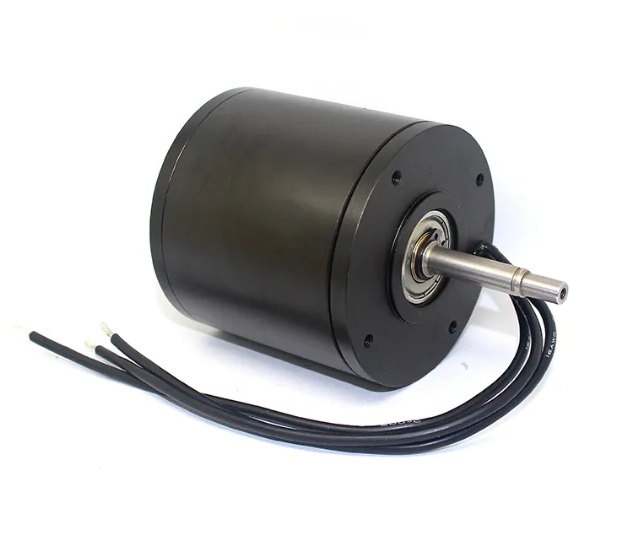
The underwater thruster BLDC motor is a critical component of underwater unmanned vehicles, submersibles, and small marine propulsion systems. Its operating environment is unique, with long-term immersion in water or near-water conditions. During operation, the BLDC motor generates significant heat. Insufficient cooling can lead not only to efficiency loss but also to insulation degradation or even motor failure. Understanding the cooling principles of underwater thruster BLDC motors and choosing the appropriate cooling method is essential for system reliability and extended service life.
Heat Generation in Underwater Thruster BLDC Motors
The BLDC motor’s heat primarily comes from three sources: Joule heating from the stator and rotor windings, core losses including hysteresis and eddy currents, and mechanical friction combined with hydrodynamic drag. Since the BLDC motor operates submerged or near water, heat must be transferred from the motor housing and propulsion structure to the surrounding fluid. The efficiency of this heat transfer directly affects the motor’s temperature rise, which impacts output power and operational longevity.
Natural Cooling Principles
Natural cooling, also called passive cooling, relies on heat conduction and natural convection with the surrounding fluid to dissipate the BLDC motor’s heat. This method does not require additional pumps or cooling circuits, making it simple, low-maintenance, and suitable for lower-power or short-duration underwater thruster BLDC motor applications.
The core mechanisms of natural cooling include conduction, convection, and radiation. Heat generated inside the BLDC motor is conducted through the copper windings, iron core, and housing to the surface, and then dissipated into the surrounding water via natural convection. Although radiative heat transfer underwater is limited, it still contributes to overall thermal balance. Natural cooling is simple, reliable, and low-risk, but its efficiency is limited by water flow and ambient temperature. High-power or continuous-operation BLDC motors may experience excessive temperature rise under this method.
Water Cooling Principles
Water cooling dissipates heat by circulating water to remove heat directly from the BLDC motor, significantly improving cooling efficiency. Water cooling systems typically use internal or external cooling chambers within the motor housing, where pumps or hydrodynamic flow move water across heat-generating areas, carrying heat away quickly.
The main advantages of water cooling are high forced convection efficiency and uniform temperature distribution, allowing high-power BLDC motors to operate continuously without overheating. Water’s high specific heat capacity enables effective heat absorption and transfer, reducing the risk of local hot spots. However, water cooling systems are more complex, requiring piping, pumps, and reliable sealing. Cooling effectiveness is sensitive to water quality and flow rate, and maintenance costs are higher than for natural cooling.
Key Considerations for Cooling Method Selection
In practice, natural cooling is ideal for low-power, short-duration, or cost-sensitive underwater thruster BLDC motors due to its simplicity, reliability, and ease of maintenance. Water cooling is preferred for high-power, continuous-operation, or deep-water applications, where temperature stability and extended motor life are critical. Choosing the proper cooling method requires evaluating motor power, duty cycle, environmental conditions, and maintenance capabilities to ensure safe and efficient operation.
Conclusion
Cooling is a critical factor in the reliability and efficiency of underwater thruster BLDC motors. Both natural and water cooling methods have advantages and limitations. Understanding their principles and suitable applications enables informed design, selection, and maintenance decisions. By optimizing cooling paths, improving heat transfer efficiency, and selecting the appropriate cooling method, temperature rise can be minimized, service life extended, and overall thruster performance and stability ensured—providing reliable operation in underwater environments.